Worklio
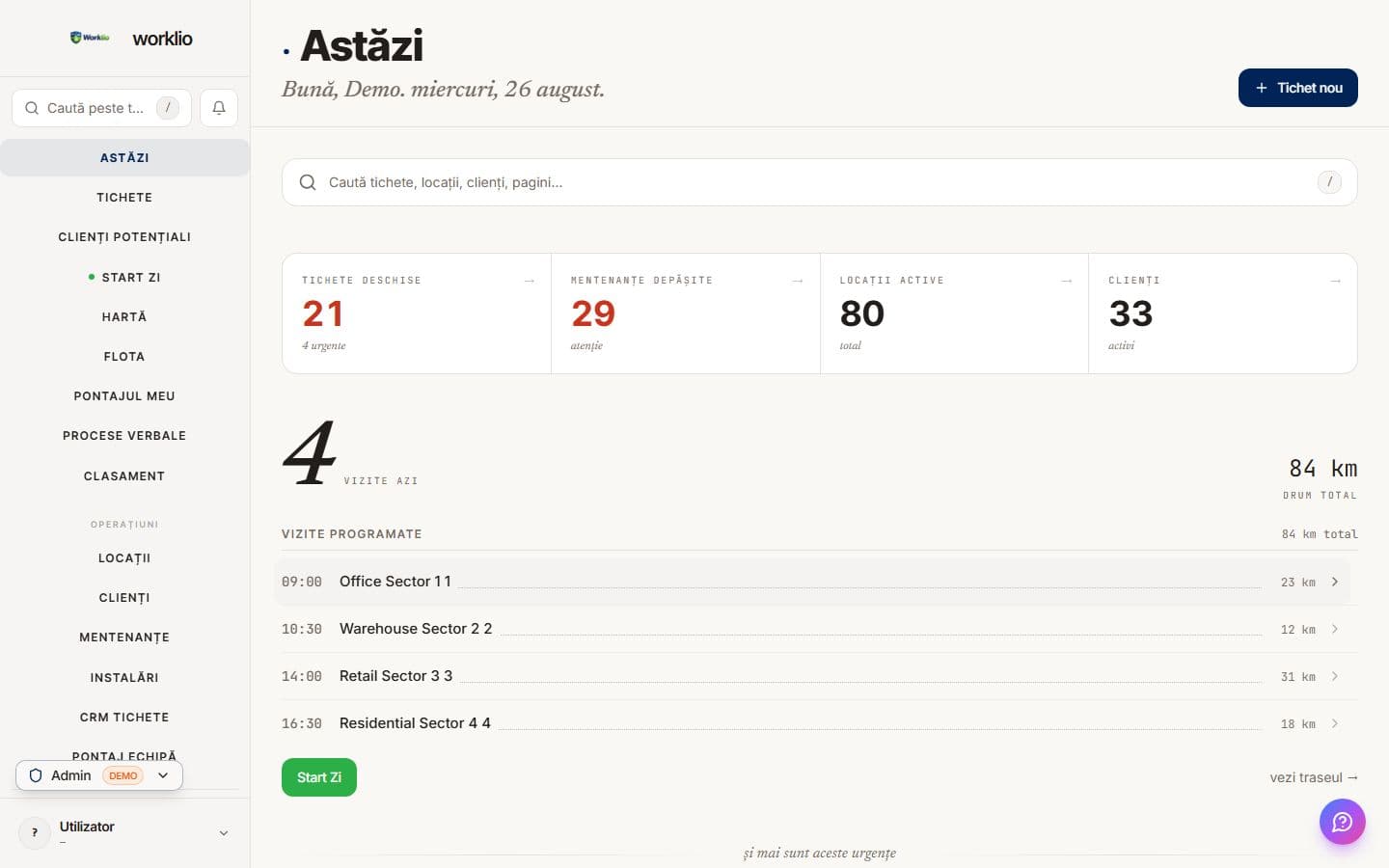
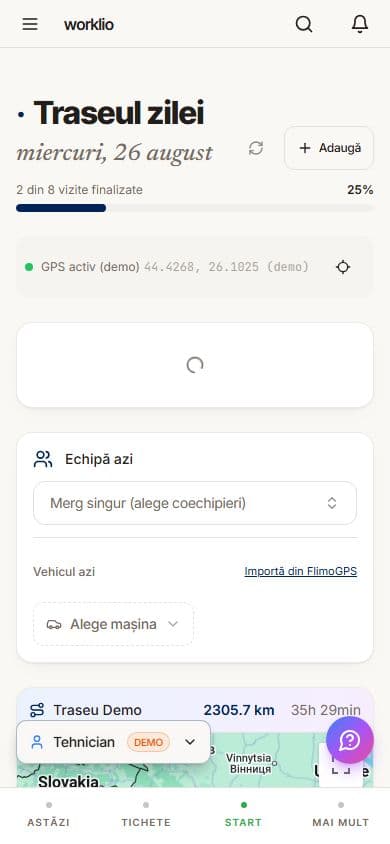
Fleet, tickets with deadlines and invoicing in one system: the dispatcher sees the office, the technician sees the day's route on their phone.
Built forA service and maintenance company that uses it every day in dispatch. I use it for my own call-outs as well — but the product belongs to the client, not to me.
Context
Field service · fleetThe dispatcher kept the fleet in a spreadsheet, the tickets on a phone and the invoices in a different program. The same job was written down three times, in three places that did not talk to each other, and when a client asked why something had taken so long, the answer had to be rebuilt from memory instead of read off a history. They needed one place where a job is written once and stays there, from the first call to the invoice.
Architecture
A job is one record, from the first call to the invoice.
The data is written once. The invoice cannot say anything the signed work order does not, because both read from the same place.
The field app is separate from dispatch, on the same database.
The technician needs the day's route on a phone, not the whole panel. Dispatch sees the same data without making a call to find out where somebody is.
The assistant answers from the equipment manuals, and hands over what it cannot find.
Repeated questions from the field stop going through dispatch, but nothing is left unanswered: the unknown is escalated, not guessed.
What I built
Tickets with an SLA
Every call-out has a deadline and an owner, and the history stays with the client.
Fleet and route
The technician sees the day's route on their phone; the dispatcher sees where each vehicle is.
Invoicing from the job
A signed work order becomes an invoice, with no data typed in a second time.
Assistant on the manuals
A chatbot trained on the equipment manuals answers questions from the field; what it cannot find there, it hands to the dispatcher.
How it looks
Stack
Result
- The separate spreadsheet the fleet was kept in.
- The invoicing program kept outside the system.
- Writing the same job three times, in three places that did not talk to each other.
- Rebuilding from memory the answer to why a job took as long as it did.
- A job's history is read on the client, with a deadline and an owner on every call.
- Dispatch sees where each vehicle is, and the technician sees the day's route on a phone.
- The signed work order becomes an invoice, with no data typed again.
MCPSpend
Want something similar?
Describe your workflow and I tell you what would change compared with the project above — and how long it would take.